


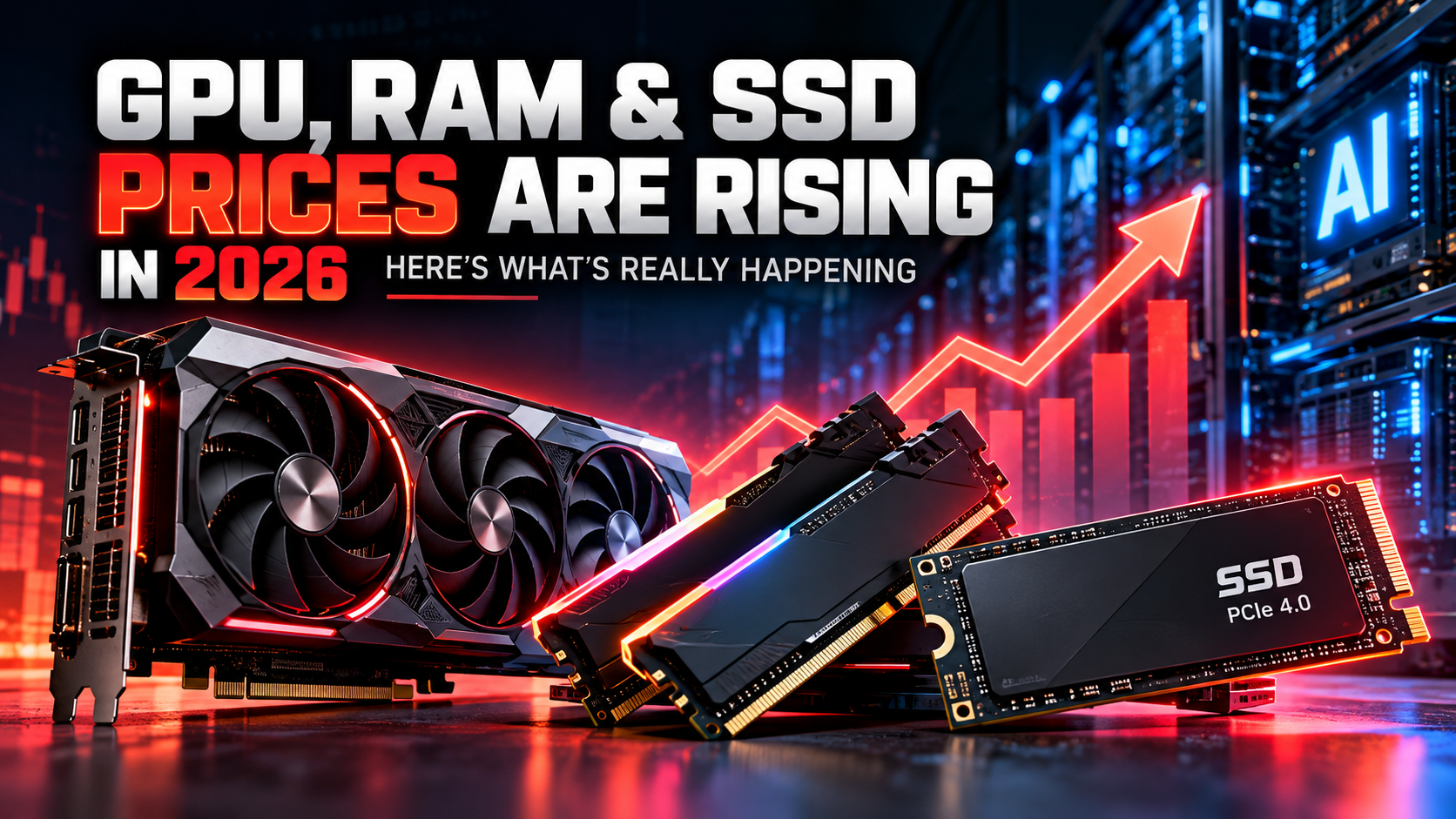
GPU, RAM & SSD Prices Are Rising in 2026 — Here’s What’s Really Happening

For years, PC builders became accustomed to a familiar cycle: new hardware arrived, older hardware became cheaper, and waiting a few months could often save a meaningful amount of money.
In 2026, that formula has become much harder to rely on.
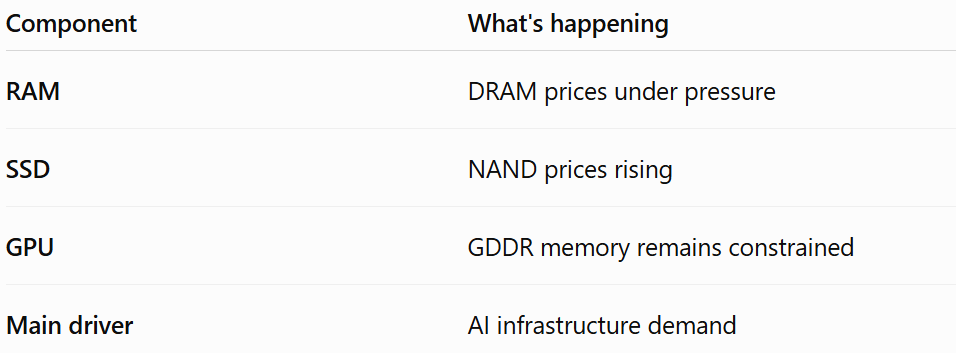
Graphics cards are becoming more expensive. RAM prices have climbed dramatically. SSDs are no longer following the predictable downward price curve buyers became used to. And behind all three markets is a common force reshaping the semiconductor industry: the enormous amount of memory and computing capacity being consumed by artificial intelligence.
This is not simply another short-term component shortage.
The PC hardware market is increasingly competing with AI data centers for the same underlying semiconductor manufacturing capacity.
The AI Boom Is Changing What Gets Manufactured
The simplest way to understand the current crisis is to look beyond the gaming PC.
Modern AI systems require enormous amounts of computing power and memory. Cloud providers and AI companies are deploying increasingly large data-center clusters built around accelerators, high-bandwidth memory and high-capacity storage.
That demand has changed the economics of semiconductor manufacturing.
Memory manufacturers have strong incentives to prioritize products aimed at servers and AI infrastructure, particularly high-bandwidth memory (HBM) and server DRAM.
According to TrendForce, manufacturers are continuing to shift advanced production capacity toward server DRAM and HBM, tightening supply for conventional DRAM used in PCs and other consumer devices.
And the pressure is not disappearing.
TrendForce’s latest Q4 2026 outlook forecasts conventional DRAM contract prices to increase by 10–15% quarter over quarter, while NAND Flash contract prices are expected to increase by 15–20%.
In other words, the memory crisis has moved beyond a temporary spike.
RAM: From Cheap Upgrade to Major PC-Building Expense
RAM has perhaps become the clearest example of how dramatically the market has changed.
Not long ago, 32GB of DDR5 was considered a relatively affordable upgrade for a gaming PC. In 2026, that same capacity can represent a surprisingly large portion of a system’s total budget.
Tom’s Hardware reported in June that the cheapest 32GB DDR5 kits in the U.S. had reached roughly $375, while some kits that had previously sold for well below $100 had climbed dramatically.
The underlying reason is not simply that consumers suddenly started buying more RAM.
AI data centers require enormous quantities of memory, and manufacturers have redirected capacity toward higher-margin server products.
That leaves traditional PC memory fighting for a smaller share of available production.
The result is a simple chain reaction:
More AI demand → more server memory production → less relative capacity for consumer DRAM → higher PC memory costs.
And the problem could persist.
Micron’s latest outlook indicates that the supply-demand balance for memory could remain particularly tight into 2027 and 2028 as AI infrastructure investment continues.
SSDs Are Caught in the Same Storm
If RAM is one side of the problem, SSDs are the other.
SSDs use NAND Flash rather than DRAM, but the underlying market is experiencing a similar shift.
AI workloads increasingly require enormous amounts of storage for datasets, models, inference workloads and increasingly sophisticated caching systems.
That demand is changing the economics of NAND Flash. Manufacturers have increasingly focused on higher-value enterprise applications, particularly data-center SSDs, while consumer storage competes for available production capacity.
For PC buyers, this matters because SSD prices are closely tied to the broader NAND market. When manufacturers face stronger demand from enterprise customers and limited production capacity, consumer SSD prices can come under pressure as well.
The situation is particularly important for high-capacity drives. As gaming libraries, creative applications and AI-related workloads continue to grow, buyers increasingly want 2TB, 4TB and larger SSDs rather than smaller drives.
TrendForce’s latest market outlook expects NAND Flash contract prices to remain under significant pressure in the fourth quarter of 2026, with AI and data-center demand playing an important role in the market.
The Storage Market Is Changing
The traditional expectation was that SSD storage would become cheaper over time as NAND production expanded and competition increased. That trend has not disappeared completely, but the current market shows why consumers cannot always assume that waiting will result in lower prices.
For PC builders, the practical takeaway is simple: storage should be selected according to actual requirements rather than assuming that a larger SSD will automatically become cheaper a few months later.
And Then There Are GPUs
At first glance, GPU prices might appear to be a separate issue.
They aren’t.
Modern graphics cards require large amounts of high-speed graphics memory, such as GDDR6 and GDDR7. As memory manufacturing becomes increasingly constrained, the cost of that memory can directly affect graphics-card production.
TrendForce reports that graphics DRAM remains constrained and that GDDR7 demand is increasingly supported by AI chips. At the same time, suppliers are reducing GDDR6 production while advanced capacity remains under pressure from server applications.
That creates another chain reaction:
AI demand → memory capacity pressure → higher GDDR costs → higher GPU manufacturing costs → higher graphics-card prices.
The effect is already visible in retail pricing.
PC Gamer’s year-over-year tracking found significant increases across several current-generation graphics cards. Its August comparison showed, for example, the RTX 5060 Ti 16GB up around 51% from the previous year, the RTX 5070 up around 37%, and the RTX 5090 up around 83% in the tracked U.S. market.
These are U.S. retail observations, not direct Nepal pricing, but they demonstrate the scale of the international pricing pressure.
The Hidden Problem: VRAM
There is another reason GPU prices are particularly vulnerable.
Modern AI applications are extremely memory-intensive.
That means higher-capacity memory is becoming strategically valuable.
Reports in 2026 have highlighted increasing costs for higher-density GDDR7 modules. One report cited by TrendForce suggested that certain 3GB GDDR7 modules were costing dramatically more than conventional 2GB modules, creating additional pressure on graphics-card designs with larger VRAM configurations.
This matters because VRAM is no longer just a specification gamers look at on a box.
It has become part of the broader competition for advanced memory manufacturing.
Why Can’t Manufacturers Simply Make More?
This is where the situation becomes more complicated.
Semiconductor manufacturing capacity cannot simply be doubled overnight.
Building and qualifying new fabrication capacity requires enormous capital investment, specialized equipment, cleanrooms, engineering resources and—most importantly—time.
Micron, for example, has been expanding manufacturing capacity, but some new wafer output is not expected until 2027.
At the same time, AI infrastructure companies are signing long-term supply agreements and committing substantial amounts of capital to secure memory.
That makes it difficult for consumer markets to quickly reclaim capacity.
The result is a market where supply is increasing—but not necessarily fast enough to match demand.
What Does This Mean for PC Builders?
For someone building a PC in 2026, the traditional strategy of simply waiting for prices to fall deserves more careful consideration.
That does not mean every component should be purchased immediately.
It means buyers should understand which components are experiencing structural supply pressure and which ones may still have meaningful price competition.
RAM and SSD pricing deserve particular attention because they are directly exposed to the broader memory market.
GPUs are also affected, especially models using expensive or high-capacity graphics memory.
Meanwhile, prices can still vary significantly between brands, retailers, distributors and regions.
A good deal today may therefore have more value than it appears on paper—but buyers should compare the complete system rather than focusing on one component.
What About Nepal?
For Nepali PC buyers, global component pricing is only the beginning.
Local pricing is affected by international component costs, shipping, exchange rates, distributor inventory, taxes and the replacement cost of stock.
That means a graphics card or RAM kit purchased by a Nepali retailer several weeks ago may have a completely different replacement cost today.
This is particularly important when comparing prices between different sellers.
A retailer selling older inventory may still have components purchased at an earlier, lower price.
Another seller replacing inventory at today’s wholesale cost may have to charge significantly more.
Both prices can therefore exist in the same market.
For customers, this is one reason why simply comparing a product’s current price with its historical MSRP does not always tell the complete story.
Should You Buy Now or Wait?
There is no universal answer.
If you need a PC for gaming, work, editing, rendering or business today, the decision should be based on your actual requirements and budget rather than attempting to predict the exact bottom of the market.
If your current PC is working perfectly and an upgrade is optional, waiting may make sense.
But if a system is already required for work or study, delaying a purchase purely in the hope of a major price collapse carries its own uncertainty.
The memory market is currently being shaped by long-term AI infrastructure investment, and industry forecasts indicate continued pressure into 2027 rather than an immediate return to the unusually cheap memory environment many PC buyers became accustomed to.
The Bigger Picture
The 2026 PC hardware price crisis is not simply about greedy retailers, expensive GPUs or a temporary shortage.
It is a consequence of a much larger transformation in computing.
The world is building enormous AI infrastructure, and those systems require enormous amounts of compute, memory and storage.
The same semiconductor ecosystem that supplies gaming PCs also supplies that infrastructure.
As AI companies compete for capacity, consumer hardware is increasingly being forced to compete for the same resources.
That does not mean affordable gaming PCs are disappearing.
It does mean the era of constantly falling component prices can no longer be taken for granted.
For PC builders, the smartest approach in this environment is not panic buying.
It is understanding the market, comparing total system costs, choosing components according to actual workloads, and recognizing when a genuinely good deal appears.
Because in 2026, the most expensive part of building a PC may no longer be the processor.
It may be waiting for the market to become cheap again.
Sources & Further Reading
- TrendForce — 2026 Q4 Memory Price Outlook and DRAM/NAND market analysis.
- Reuters — Micron’s latest AI-memory demand and capacity outlook.
- Tom’s Hardware — 2026 DDR5 pricing and consumer memory market coverage.
- PC Gamer — 2026 graphics-card price tracking.
- Tom’s Hardware — Current GPU pricing and the impact of AI-driven memory demand.